
Walking into any Esselunga store is more than a simple grocery run, it is a lesson on how a company can stay relevant for 69 years.
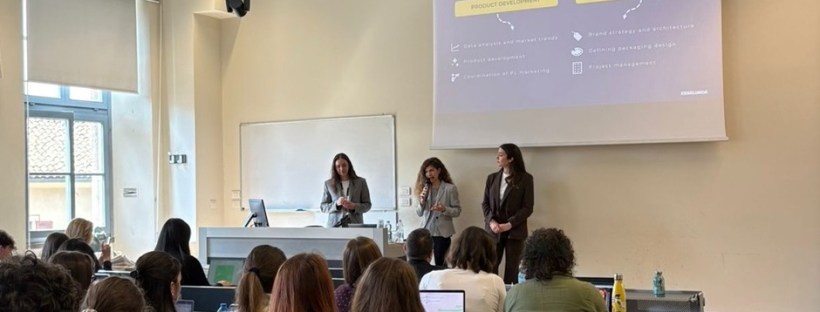
During our recent Marketing Management and Marketing Planning class we had the opportunity to hear from three guest speakers from Esselunga: Francesca Carsana, Private Label Product Development Manager & International Relations Coordinator; Federica Dalla Costa, Private Label Product Development Specialist & International Relations Coordinator; and Chiara Flaminio, Private Label Product Branding Specialist.
They demonstrated that the brand’s success is not just about technology and innovation, but on its ability to communicate through their own labels and adapt their product strategy to continuously changing consumer needs.
A DIVERSE PORTFOLIO FOR EVERY CONSUMER
Esselunga does not just sell third-party merchandise. A major part of their strategy involves Private Labels, which are goods manufactured either by external suppliers or by the company itself but sold under Esselunga’s own brand names.
To cover every customer need, Esselunga has developed a diverse portfolio of brands. These include Esselunga for everyday value, Esselunga TOP for premium gastronomy, and Esselunga Bio for organic options, and Equilibrio for the wellness segment.
They also offer Naturama for fresh products and controlled supply chains, Smart for budget-conscious shopping, and specialized lines like Cucina Esselunga for ready-to-eat meals and Elisenda for high-end pastries.
THE STRATEGIC POWER OF PRIVATE LABELS
Private Labels are no longer just cheaper alternatives to offer to clients, but are real brands designed to build customer loyalty and trust by expressing core values, identity and uniqueness. If used tactically, they serve as a long-term strategic asset, offering consumers exclusive items that can’t be found elsewhere.
In the past, these offerings tried to mimic market leaders, adopting similar colour palettes and design layouts so that customers could easily identify them as the alternative to mainstream products.
Recently, Esselunga moved away from this approach in order to build a unique brand identity. This was achieved by using a distinct visual style that helps customers recognise the Esselunga family immediately.
THE EQUILIBRIO CASE: A STRATEGIC BRAND TRANSFORMATION
The best example of this shift is the Equilibrio line. The brand was created back in 2013 to help consumers find a balance between health and taste.
However, a 2021 research on brand perception showed that customers thought that the packaging looked a bit too pharmaceutical and failed at creating an emotional bond. The white backgrounds and simple floral motifs were not able to transmit the right set of sensations to customers. Furthermore, the original colour-coding system was too subtle, and shoppers were not aware of the distinctions between products.
To fix this, a major strategic relaunch was designed. While the visual restyling was a key component, the success relied on a three-pillared approach: product offerings, visual identity and communication strategy.
First, Esselunga simplified the offering by moving generic wellness products, such as whole-grain and protein-rich items, under the main Esselunga brand. This avoided customer confusion and allowed Equilibrio to focus on other dietary needs, such as gluten-free and lactose-free. This strategic move allowed Esselunga to develop new, specialised products within the Equilibrio line, giving customers the feeling of a larger and more tailored offering.
Then, the visual identity was renovated. The goal was to keep the name but change the feeling. The packaging became more food focused to create an emotional connection with the shopper. It was also introduced colour coding to make the products characteristics easier to read: blue is used for lactose-free products, orange for gluten-free, and a journey through color for nutritionally balanced options. Other colours are strategically applied to reflect the product’s flavour or main ingredient for example, brown for chocolate and red for strawberries. Blue used for lactose-free products, orange for gluten-free, and other colours are switched strategically to represent the flavour or main ingredient of the products, such as brown for chocolate and red for strawberries.
Lastly, the relaunch was supported by a full activation of the communication system, including digital channels, CRM activities, and in-store visibility.
A CALCULATED BUSINESS DECISION
This rebranding was not just about making things look pretty. It was a calculated business decision to align the brand with the wellness segment.
By moving into an engaging lifestyle brand, Esselunga has successfully strengthened Equilibrio’s position in a highly competitive market.
The main takeaway from the session is that design is a silent ambassador, but it only succeeds when backed by a solid product architecture and an integrated marketing strategy.
The success of this strategy shows that a brand survives for 69 years only by knowing exactly when it is time to reinvent itself.
Silvia Mangiavacca


