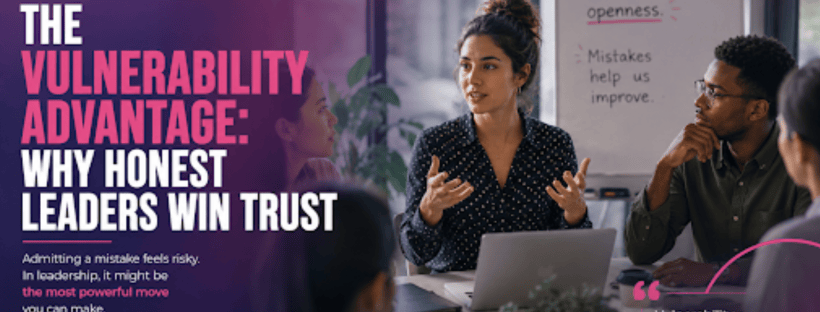
Vulnerability is no longer seen as a weakness. Honest leaders build trust by admitting mistakes and encouraging open communication.
TURNING WEAKNESS INTO TRUST
Admitting a mistake feels risky. In leadership, it might be the most powerful move you can make. For a long time, leadership was associated with certainty. A good leader was expected to always have the answer and never show doubt.
Researcher Brené Brown has challenged this idea directly, arguing that vulnerability, not invulnerability, is the birthplace of courage, connection and trust. Her research reframed a trait long seen as a weakness into one of the clearest predictors of strong and resilient relationships.
In practice, this means a leader who says “I don’t know” or “I was wrong” is not weaker. Admitting uncertainty signals honesty, and honesty is what teams use to decide whether they can trust someone. People do not follow leaders because they never make mistakes; they follow them because they know how those leaders behave when mistakes happen.
VULNERABILITY BUILDS TRUST
Vulnerability also changes how teams communicate. When a leader is open about difficulties, employees feel safer admitting their own.
This is close to what organisational researchers call psychological safety: an environment where people can speak up, ask questions or flag problems without fear of embarrassment. Teams with higher psychological safety tend to solve problems earlier, simply because nobody is hiding them.
VULNERABILITY NEEDS BOUNDARIES
Of course, vulnerability is not the same as oversharing. Effective vulnerability is selective and purposeful, not a constant stream of personal disclosure.
A leader who shares a genuine struggle related to a real decision builds credibility, while a leader who overshares unrelated personal details can undermine it. The skill lies in choosing what to share and why.
CONTEXT CHANGES THE RISK
This kind of openness is also harder for some leaders than others and context matters. In highly hierarchical or high-pressure industries, showing doubt can still be read as a liability rather than a strength.
Building the vulnerability advantage there often starts small: acknowledging a wrong prediction in a meeting, asking a junior colleague for input, or simply saying “help me understand this better” instead of pretending to already know.
WHAT IS REAL OUTLASTS
Ultimately, vulnerability works because it is difficult to fake. It cannot be scripted the way a slide deck can, which is exactly what makes it convincing.
In a workplace culture that increasingly values authenticity over authority, the leaders who admit what they don’t know are often the ones people trust the most. That trust, once built, tends to outlast any single project or presentation, which is precisely why it is worth the initial discomfort of showing it.
Claudia Cundari

 CIMO
CIMO 