
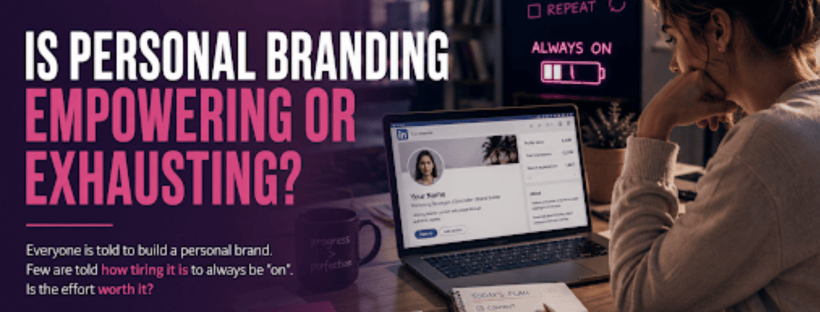
Building a personal brand can create opportunities, but it can also become emotionally exhausting if visibility turns into an obligation.
SELF-PROMOTION IN THE DIGITAL AGE
Everyone is told to build a personal brand. Few are told how tiring it is to always be “on”. Is the effort worth it? Personal branding promises real advantages.
A clear, consistent professional identity helps people get noticed, build trust and open doors that would otherwise stay closed.
Harvard Business Review frames it as a strategic asset: something anyone can shape deliberately instead of leaving to chance, by identifying what makes them distinctive and communicating it with intention. Done well, it can influence who reaches out with a job offer, a collaboration or an invitation to speak.
WHEN VISIBILITY BECOMES PRESSURE
The other side of the story is less often discussed. Constantly managing how one is perceived can become a second, unpaid job. Choosing the right photo, wording a post carefully, tracking engagement, staying visible: all of this takes time and emotional energy, and it rarely stops.
For many young professionals, the pressure to always look competent, interesting and coherent turns self-presentation into a source of anxiety rather than opportunity.
PROFESSIONALS KNOW HOW TO KEEP THE BALANCE
The line between the empowering and exhausting sides often depends on ownership. Personal branding feels empowering when it expresses something the person already believes, and exhausting when it becomes a performance for an audience. Sharing a genuine professional interest is different from posting only to appear a certain way: the first builds identity, while the second drains it.
Sustainable personal branding also depends on boundaries. Not every platform, and not every moment, needs to carry the same effort. Choosing one or two channels to invest in, instead of trying to be visible everywhere, reduces the pressure while still building a recognisable presence over time.
VISIBILITY IS NOT VALUE
Comparison is often what turns effort into exhaustion. It is easy to measure a personal brand against the most polished, most followed profile in the room, and feel behind by default.
But visibility metrics like followers or likes say little about whether a personal brand is actually working: a smaller and well-targeted network of the right recruiters, colleagues or clients is usually more valuable than a large and undifferentiated audience.
RECOGNISABLE WHEN IT MATTERS
So, empowering or exhausting? Probably both, depending on how it is approached. Personal branding works best as a tool used with intention, not as a constant obligation. The goal is not to be visible all the time, but to be recognisable when it matters.
Treated this way, a personal brand becomes something closer to a professional habit than a performance, and habits, unlike performances, do not have to be exhausting to be effective.
Claudia Cundari


