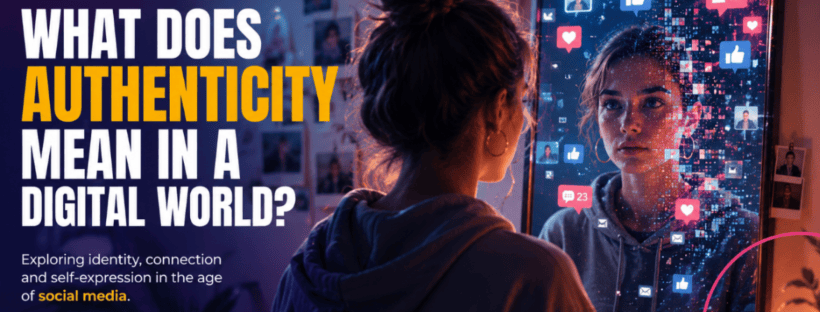
Social media has changed the meaning of authenticity. Today, being real is less about sharing everything and more about staying consistent across every platform.
THE NEW AUTHENTICITY
We curate, filter and edit ourselves online every day. So can anyone still call that “authentic”? Here’s what the word really means now.
Authenticity used to mean simply being yourself. Online, the concept has become far more complicated. Every profile, post and story is, to some degree, a construction: a chosen photo, a written caption, a filtered version of a moment.
Sociologist Erving Goffman argued decades before social media existed that all social life is a kind of performance, with a “front stage” self we show others and a “backstage” self we keep private. The internet has simply made the front stage permanent and searchable.
CURATED, BUT STILL REAL
This does not mean digital authenticity is fake. It means authenticity today is less about spontaneity and more about consistency. People trust accounts and brands that say the same things, hold the same values and show the same personality across contexts.
Even if each individual post is carefully planned, a brand or a person can be strategic about what they share and still be genuinely truthful about who they are.
WHEN CURATION GOES TOO FAR
The risk appears when curation replaces honesty rather than supporting it. Authenticity breaks down the moment the online version of someone stops resembling the offline one.
Recent research from the Pew Research Center shows that young people are highly aware of this gap: many say social media makes it easier to present a version of themselves that isn’t fully real, even as they keep using these platforms daily.
THE REAL-LIFE TEST
For communication professionals, this tension is not a problem to eliminate but one to manage.
A useful test is whether the content still holds up in a real conversation. If a claim, a tone or a value shown online would feel embarrassing or untrue face to face, it is not authentic, no matter how polished it looks. If it would hold up, curation is simply good communication.
BRANDS HAVE TO PROVE IT
Brands face the same test, on a larger scale. A company that talks about sustainability, inclusion or care for employees online is expected to show the same values in how it actually operates.
Audiences today research, compare and remember, which means the gap between a brand’s declared identity and its real behaviour is far easier to expose than it used to be. Authenticity has effectively become a form of accountability: a promise that can be checked.
CONSISTENCY IS THE NEW AUTHENTICITY
Digital authenticity, then, is not the absence of editing. It is the presence of coherence between the private and the public self.
In a world where everyone is, to some extent, their own editor, the most credible people and brands are not the ones who share everything, but the ones whose shared version never contradicts the real one.
Claudia Cundari


