
For decades, brands have appeared in our cities as temporary guests, renting billboards, displaying a message and disappearing a month later. But what happens when a brand decides to stay? When it stops acting like a visitor and starts behaving like a neighbour? From cleaning up hate speech to paying the rent for local bar shutters, drinks companies are moving from traditional advertising to a new model called Brand Urbanism.
Brand Urbanism is a specialised form of Out-of-home (OOH) marketing that involves a strategic connection between a brand and a city, in which a company funds or creates tangible improvements in the urban environment. It pursues two parallel goals: to benefit the community and to strengthen brand perception through meaningful, visible action.
For the beverage industry, this shift is more than a creative experiment and can be seen as a strategic necessity. Because their products are consumed in physical spaces like bars, town squares and neighbourhood hangouts, these brands are now investing directly in the streets where their lifestyle happens. By doing so, they redefine their role in the city, shifting from advertisers to active contributors to husband life.
DISARONNO: THE POWER OF A COMPLIMENT
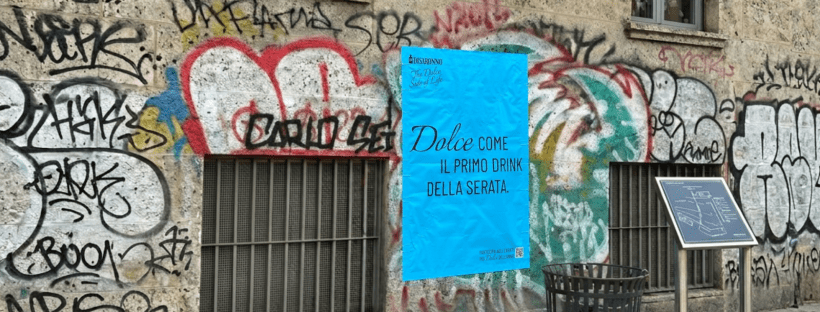
A recent example of this trend comes from Disaronno and their initiative called The Dolce Side of Life, launched in March 2026. The brand identified specific urban areas in Milan and Rome where walls were covered in hate speech and offensive graffiti – messages that weighed on the atmosphere of entire neighbourhoods .
Instead of simply cleaning the walls, Disaronno transformed them. The company partially covered parts of the graffiti with posters that creatively transformed the original insults into warm, positive and playful lines such as: “I hate being without a drink and without you”, or “Carlo, you are as sweet as the first drink of the evening”. The result was a clever form of urban intervention that cleaned the city while expressing the brand’s personality.
HEINEKEN: SUPPORTING LOCAL PUBS
Disaronno is not alone in this shift. During the pandemic, Heineken launched a campaign called Shutter Ads that completely redefined the use of urban space. Instead of investing their budget in empty highways, the company paid local businesses to turn their metal shutters into painted advertisement spaces.
Each shutter featured a simple call to action: “See this ad today, enjoy this bar tomorrow”. The ads made it explicit that Heineken was paying the bar directly, providing immediate financial support during a period of crisis.
The data proves the efficiency of this utility-based model: Shutter Ads generated 40% more media value than traditional OOH campaigns, and every participating bar successfully reopened. It was a clear demonstration that utility-based advertising can outperform conventional visibility.
A GROWING MOVEMENT
This approach is rapidly spreading across the beverage sector. Beyond the ones previously mentioned, brands like Corona has launched plastic-fishing tournaments in coastal cities, paying local fishers to remove waste from the water.
Likewise, Jameson has invited residents in Milan, Naples and Rome to propose neighbourhood improvements and then funded select projects. Meanwhile, Aperol has invested in heritage restoration by supporting the repair of historic Venetian boats.
Despite their differences, these initiatives share a common logic: brands are shifting from symbolic activism to tangible civic investment. They are rewriting the rules of engagement by embedding themselves directly into the urban landscape.
These examples prove that when a brand stops acting like a billboard and starts acting like a citizen, it creates a form of social value that traditional advertising simply cannot replicate. This shift toward urbanism represents a new frontier where the city is no longer just a backdrop – it becomes the message.
Silvia Mangiavacca


