
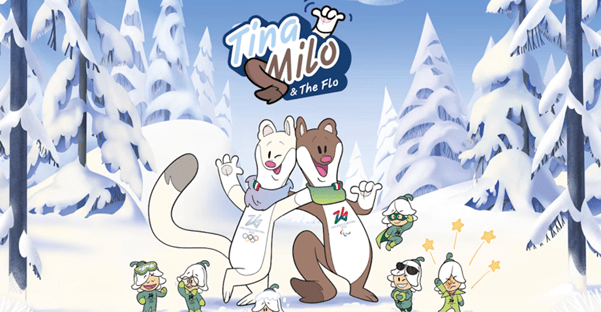
The Olympics are now finished, but the huge impact they had on Italy is still observable. The power of the mascots of the Milano Cortina Olympics is huge: they had an impact on culture and entertainment, gaining more and more visibility on social media and gaining a solid reputation. But what’s the story behind them?
Tina and Milo, the two official mascots of the Milano Cortina 2026 Winter Olympic and Paralympic Games, represented as two cheerful, light-footed stoats, are not just funny and cute representations of Alpine animals: they symbolise the resilience of the Italian mountain territory, standing for sustainability and fauna awareness. They were designed by some young students of the Istituto Comprensivo di Taverna. The students created two symbols of the Italian identity, giving space to disabilities, culture, and local ecosystems, which became a bold statement within the mascot’s idea. In fact, Milo, the short version of ‘Milan’, doesn’t have a paw: he uses its tail to move around, embracing its disability and its city-like character, being the best representative for the Paralympic games, while his white-coeated sister Tina is the best representation of the color change stoats undergo each winter.
Another detail is his fur: brown, even though in winter stoats are white, like his sister Tina, who lives in the Italian Alps. But why is that so? The design of the mascots also represents the adaptation to the city, in which becoming white due to camouflage interests, doesn’t make sense anymore.
But the choice is not casual: the two stoats bring the focus on the Alpine ecosystem, which is more and more endangered by climate change. Indeed, despite not being an endangered species, the two mascots raise the attention towards the issue of climate change: as reported by Marco Granata from the University of Turin, “the stoat appears unable to track this expansion, suggesting a growing predator-prey mismatch. These findings indicate that despite its current Least Concern status in Italy, the stoat may warrant reclassification as Vulnerable under IUCN Criterion A3c.”
The Olympic committee’s choice of using Tina and Milo goes over the brand image: it is a statement, a positioning, in which the territory becomes the dominant factor to be preserved. Using them as mascots indicates the core value of the Olympics, embracing cultural differences, without forgetting the local fauna and ecosystems, giving nature a global-heard voice.
Viola Spreafico

 CIMO
CIMO 